
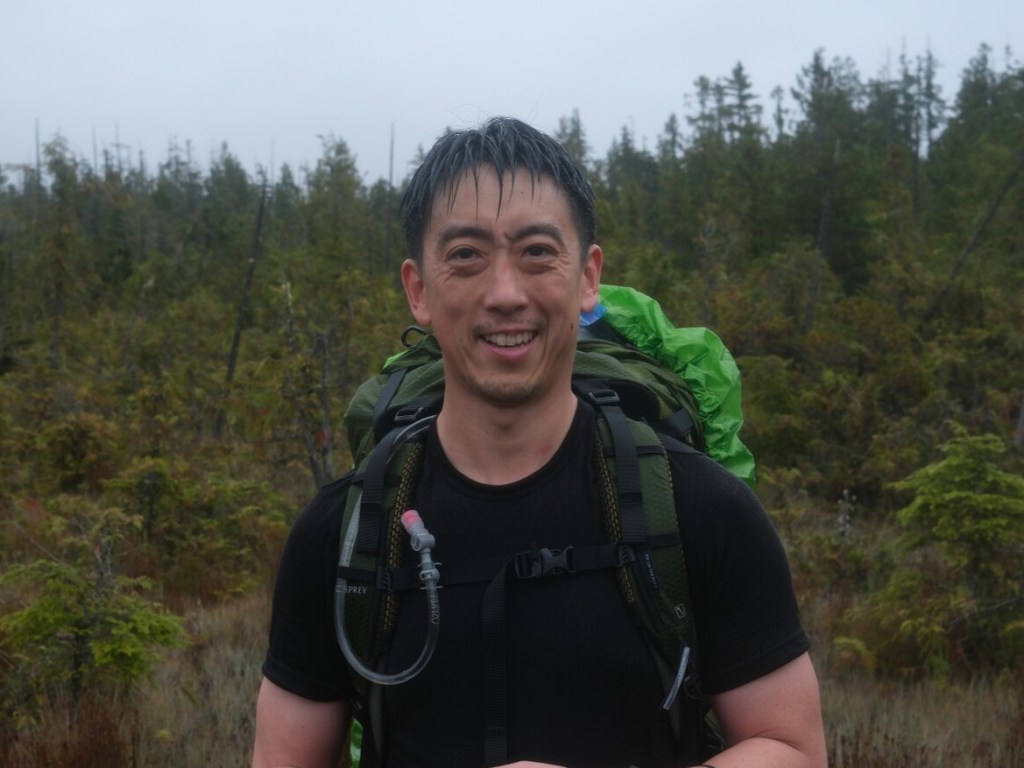
In September, my best friend (“B.”) and I completed the West Coast Trail (“WCT”) over seven days / six nights. While the trail is not extremely technical or have that much in elevation changes, it does require sufficient strength, endurance and stability to walk for 75 kilometres over slippery tree roots, broken and/or wet boardwalks, mud, bogs, ladders, fast-flowing rivers and gravelly beaches, all while carrying all your food, water and equipment (tent, sleeping bag, etc.). Parks Canada does not recommend it for beginner hikers.
Given that it had been a while since I had done a long multi-day hike, I altered my training program to prepare for the trip. Below are some of the exercises that I used.
- Rucking
- The best way to train for any activity is to do the activity. As much as general strength training and conditioning can get your muscles stronger and heart generally ready for an activity, the more closer you can train to the activity, the more direct carry over there is. So I did spend quite a bit of time walking around in my hiking boots with a heavy weight in a backpack. If I could, I would walk longer periods of time, up to two hours. If I was short on time, I would overload my pack with 60lbs of weight and knock out a half-hour climb up the hill near my house.
- A side benefit was that I was also breaking in my hiking boots. The only thing missing from rucking, especially in an urban environment, was training the body to deal with things like really uneven ground, jumping with weight around mud, and slippery boardwalks and roots.
- Squats and walking lunges
- Beyond just improving the muscular endurance of the legs, getting them strong was another goal in preparing for the hike. The easier the hike feels, the longer I can go. And how do you make the hike feel easier? Get the legs stronger.
- Strength also allowed me to better handle the little slips and unexpected movements better. Regardless of how careful I was, there were times when I stepped on a pebble going downhill and jammed my leg to stop, or slipped on a slippery boardwalk. Having stronger quads and glutes allowed me to stop and recover easier.
- Petersen step-ups, Poliquin step-ups, and isometric knee extensions
- As a test run, B. and I went on an overnight hike to the first camp of the Hudson’s Bay Company (1849) Heritage Trail (“HBC Trail”) near Hope, B.C. in August. We had never done the trail before and found out that the 7 km to the first camp was pretty much all uphill. Which meant that coming back the next day was all downhill. My knees, especially just below the kneecap, were pretty sore when I got back home. It took a few days to recover.
- So to strengthen the musculature around the knee, like the VMO, I did Petersen and Poliquin step-ups. Poliquin step-ups most represented the act of walking down a slope. Petersen step-ups were also good as they were similar to stepping off logs, etc. I also added isometric knee extensions to try to strengthen the tendons around the knee.
- I only had a month to work on these before the real hike, but in the end, the WCT did not have the same elevation changes as the HBC Trail, so it was probably sufficient. My knees were a little sore after the first and second days of the WCT. We started from Gordon River, so those days involved going up and down in elevation, walking through a lot of mud and roots and pushing 15 kms per day, so it was kind of expected.
- My knees were good to go in the mornings after some rest, so it was just a matter of managing the volume during the day. I used poles to allow the upper body to help with climbing over things. We also slowed things down after day two since we weren’t in a rush and had already covered 30 km of the 75 km. Finally, the remaining part of the trail had a lot of beach and not as much elevation changes, so was easier in general. I didn’t have any knee soreness after the second day.
- Ankle conditioning exercises
- No matter how good your boots are and how carefully you step, there’s always a risk of slipping and twisting something when hiking. This is especially true of the WCT where there are slippery roots, old ladders, fallen trees, broken bridges and broken boardwalks, most of which are wet and/or covered in mud. So getting the ankles ready to handle the hike were a priority for me when I first started preparing.
- I trained my ankles with toe walking, heel walking, eversion walking, and inversion walking. I also did eccentric / plyometric style exercises, specifically, bouncing split squats, “hop, stop, and drop”, and ankle bounces.
- Toe/heel walking is exactly what it sounds like, walking on your toes/heels for a period of time/distance. Eversion walking is walking on the inside edge of your foot, while inversion walking is walking on the outside edge. Inversion of the ankle was probably the highest ankle sprain risk during a hike, so by putting the ankle in this position under controlled strain allowed the ligaments and supporting muscles in this area to get accustomed to the position.
- Bouncing split squats are a plyometric exercise where you get down into the bottom of the split squat position and bounce, putting eccentric strain on surrounding musculature of the ankle. “Hop, stop and drop” is similar in that you hop forward slightly and try to drop into the split squat position while maintaining control, i.e., not smashing your back knee into the floor. Ankle bounces are just that, bouncing on the balls of your feet, flexing only at the ankles.
- While I probably didn’t start early enough to really physically change the ligaments (it takes 3-6 months of consistent training to have really noticeable improvements to tendons and ligaments), the couple of months where I did practice these exercises probably allowed my body to get some adaptation to the positions. I also had the ankle support of my hiking boots to lean on a bit in the even of a slip. Luckily, there were no ankle issues on the hike.
- 4×4 Norwegian Protocol
- While the rucking probably had me covered for long steady state cardio, I also wanted to make sure I could handle any long, hard pushes. So I did some VO2Max training using the 4×4 Norwegian Protocol. Four minutes hard (85%+ of max heart rate) followed by three minutes easy, four times.
- I used the assault bike as it was easier to control intensity. I also used the Morpheus heart rate monitor and app to track my heart rate during the exercise.
- Don’t know if my VO2Max improved at all since I didn’t take a baseline or test after, but I didn’t feel overly strained during the WCT. We were working sufficiently hard since we would finish most days sweaty, but I never felt totally pushed to my limit. And, of course, we could always take a break if really needed it. B. and I didn’t treat the WCT as a race to be finished. Some of the days after the first two days were pretty short and chill.
To be honest, I was not as organized and disciplined with my training for the WCT as I could have been. We knew in January when we were going, but I didn’t really start training for the WCT until about July. There were just other things that occupied my training time. In the end, my general strength and conditioning plus the exercises above was sufficient enough to get me through the WCT with enjoyment.
But now that I have been through the WCT, here are a few things that I would add:
- Balancing and jumping exercises
- The WCT involved a lot of walking on logs, roots, and broken board walks, often slippery. Unless you wanted to get your boots totally muddy, there were often areas where you would have to bound from slippery root to slippery root to get over a particularly muddy spot. While have poles helped, I would have liked to have had a bit more practice before hand so I knew my limits.
- The exercises would probably be like a parkour cross obstacle course. Have relatively thin platforms at varying heights and distances and practice hopping from one to the next. Hold a couple of PVC pipes in hand to simulate hiking poles.
- Step-ups and step-downs
- There was quite a bit of climbing ladders, and up and over fallen logs. I’m not a tall person, so getting up and over the huge fallen old-growth cedar logs were a bit of a challenge at times. I had to use my hiking poles for support/boosting myself up and would often just resort to scooting on my butt to get down. There were also a lot of climbing up and over roots.
- So next time, I would probably also add step-ups and step-downs, in addition to the Poliquin step-ups. The unilateral strength and ability to lift your bodyweight and pack up and over was probably more applicable than the walking lunges that I did.
 Musubi Fitness
Leave a comment